
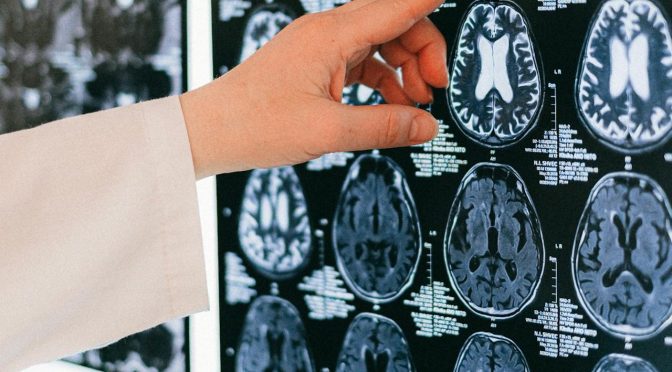
I was talking about substance dualism with Rose, and showing her new academic books (one, two) about it. So, I decided to blog something related to that. Today’s post is about Jeffrey Schwartz – a research psychiatrist at UCLA. His research shows that mental effort can change your brain chemistry. Would you like a scientific argument for non-physical minds? Read on, and I’ll show you one.
First, let’s see something completely secular, from UCLA Health, just to explain who Jeffrey is, and what he does:
Thanks to neuroplasticity — the brain’s ability to create and reorganize neural connections — people can find relief from anxiety, depression, substance abuse, obsessive-compulsive disorder and everyday mental health challenges, says Jeffrey Schwartz, MD, a research psychiatrist with the UCLA Department of Psychiatry.
Dr. Schwartz outlined his four-step method for dealing with mental health challenges at the Emerging Themes in Behavioral Health conference, April 28, at the UCLA Luskin Conference Center(Link is external).
The four steps combine mindfulness with cognitive behavioral therapy, which results in what he calls “self-directed neuroplasticity.”
Why is this argument for substance dualism? Well, his research shows that when humans exert “mental effort” in certain structured ways, they can actually change their brains. This contradicts the materialist / physicalist view which is that your experience of consciousness is an illusion that is entirely controlled by deterministic chemical processes in your brain.
Here’s a video about his research:
And here’s a summary of the research, published in First Things, and authored by William Dembski.
Excerpt:
Schwartz provides a nonmaterialist interpretation of neuroscience and argues that this interpretation is more compelling than the standard materialist interpretation. He arrived at this position as a psychiatrist specializing in the treatment of obsessive-compulsive disorder (OCD).
[…]From brain scans, Schwartz found that certain regions in the brain of OCD patients (the caudate nucleus in particular) exhibited abnormal patterns of activity. By itself this finding is consistent with a materialist view of mind (if, as materialism requires, the brain enables the mind, then abnormal patterns of brain activity are likely to be correlated with dysfunctional mental states). Nonetheless, having found abnormal patterns of brain activity, Schwartz then had OCD patients engage in intensive mental effort through what he called relabeling, reattributing, refocusing, and revaluing (the 4 Rs).
[…]Schwartz documents not only that patients who undertook this therapy experienced considerable relief from OCD symptoms, but also that their brain scans indicated a lasting realignment of brain-activity patterns. Thus, without any intervention directly affecting their brains, OCD patients were able to reorganize their brains by intentionally modifying their thoughts and behaviors. The important point for Schwartz here is not simply that modified thoughts and behaviors permanently altered patterns of brain activity, but that such modifications resulted from, as he calls it, “mindful attention”-conscious and purposive thoughts or actions in which the agent adopts the stance of a detached observer.
So mind-brain interaction is not a one-way street. Everyone knows that you can alter your consciousness, beliefs, moods, sensations, etc. by changing your brain, e.g. – with drugs. But it turns out that you can also will to focus your thoughts on certain things in order to change your brain chemistry. So the causation is not just bottom-up, but also top-down.
Mindfulness therapies – which are documented in the research papers published by Schwartz (like this one and this one and this one)- assume the existence of free will. Naturalists don’t like this research because naturalists don’t believe in free will. So what do you find more trustworthy? The evidence? Or the philosophy? Me, I trust the evidence more than the philosophy.
 WINTERY KNIGHT