
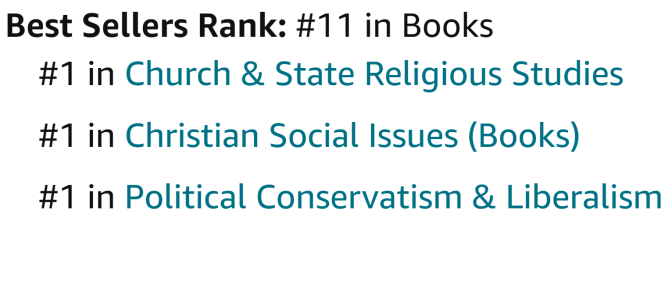
Megan’s new book is popular that it’s up to #11 on Amazon as of Sunday night, when I am writing this post. The book talks about how some popular evangelical pastors and teachers have aligned themselves with the secular left on issues like abortion, LGBT, immigration, global warming, health care, etc. I got the audio version, read by the author, and I’m enjoying it immensely.
So what’s in the book? Here is one article in First Things containing a sample chapter about how some evangelical pastors and leaders align themselves with the secular left on LGBT policy.
It says:
In 2000, Jon Stryker, gay heir to a one-hundred-billion-dollar surgical supply conglomerate, launched the Arcus Foundation, a grant-making institution that soon became the largest funder of LGBTQ initiatives in the United States. But after legislative defeats like the passage of a 2008 California law banning gay marriage, Stryker’s foundation began devoting tens of millions of dollars to, in its words, “challenging the promotion of narrow or hateful interpretations of religious doctrine” within every major Christian denomination.
[…]Between 2014 and 2018, the Reformation Project, a brand-new organization led by twenty-three-year-old Harvard dropout Matthew Vines, received $550,000 in grants. The purpose of the funding, according to Arcus, was to “reform church teaching on sexual orientation and gender identity among conservative and evangelical communities.”
[…]Enter Greg and Lynn McDonald. In 2015, they founded Embracing the Journey, an organization for Christian parents of LGBTQ children, at the urging of North Point’s executive director, Bill Willits. They had recently relocated to the Atlanta area and had begun attending services at the church. Over a breakfast meeting with Willits early in the year, Greg happened to share that his son had come out as gay in 2001, and he described how his and Lynn’s process of acceptance eventually led them to become informal counselors to other parents of gay and transgender kids. Willits was “captivated” by their story and revealed that North Point had already begun exploring new ministries in that vein. He urged them to film a video for Stanley’s Drive Conference that May.
As Stanley introduced the McDonalds’ video to approximately two thousand church leaders from all over the country, he urged those leaders not to view homosexuality through a “political” lens. Instead of suggesting that ministers use the Bible as their foremost frame of reference, he urged the audience to approach the issue through a “relational lens.” His example for relational was the McDonalds’ story.
And this part was interesting. As someone who has tried and tried and tried to get evidential apologetics into churches, I was astonished to see how churches approached Vines’ teaching material on LGBT:
As might be expected, given how seriously he takes his mission, Vines’s courses are far more rigorous than the kind of light, Wednesday night discussions the typical evangelical church offers on such subjects, if it offers them at all. Over a period of three months, the Reformation Project requires participants of one program to complete the equivalent of an advanced college course, all for the purpose of preparing to subvert the faithful churches Vines has called “the last stronghold of homophobia.”
When I was reading this article, I could not help but think of the episodes of Knight and Rose Show that Rose and I did about the definition of marriage, and then our interview with Dr. Frank Turek about LGBT as a whole. Naturally, our conversations were about evidence. We wanted to follow the advice of 1 Peter 3:15, and give an evidential defense of Jesus’ views on these issues, that would be convincing to non-Christians. But Andy Stanley doesn’t like evidence, he wants to be “relational”. You know, “don’t judge”.
Here’s another article in The Federalist with a sample chapter about evangelical pastors and immigration.
It says:
In January 2020, Baptist Press, the house organ of the Southern Baptist Convention, published a lie. The question is whether the outlet knew at the time that it was a lie.
The article was not attributed to any specific author and was labeled an “explainer.” It claimed to debunk reporting from the conservative news outlet Breitbart, which revealed that the Evangelical Immigration Table, a group that lobbies for various amnesty policies in the name of Jesus, was funded by left-wing, atheist billionaire George Soros. This was not a small matter because, largely under the direction of, first, Richard Land, and then Russell Moore, the SBC’s Ethics and Religious Liberty Commission had become a key leader in the EIT. Nor were Land and Moore alone. Leadership for a host of trusted evangelical organizations, including the Council for Christian Colleges and Universities, the NAE, World Relief, InterVarsity Christian Fellowship, Focus on the Family, Prison Fellowship Ministries, and the Wesleyan Church, had joined hands with the EIT. If it was being bankrolled by Soros, they would all have a lot of explaining to do.
[…]From the outset, the group focused not on encouraging Christians to meet the material and spiritual needs of immigrants in their own communities, something few would object to, but on pushing them to lobby lawmakers for specific legislation.
[…]By late 2013, the group was soliciting proposals for “mobilizers” to “activate” pastors and congregations, explaining that “81 Republicans in the House who may vote for immigration reform represent districts whose population is at least 20% evangelical Christian. Over the last year, the [EIT] has worked to engage pastors and congregants in 16 of the 20 states that are home to these districts.”
[…]The EIT’s efforts to see the bill passed began in earnest in January 2013, as the group pushed churches to join a 40-day study of cherry-picked Bible verses, titled “I Was a Stranger,” that they insisted applied to U.S. immigration law. Instead of studying the Bible, churches involved with the EIT began recruiting their congregants for political activism.
The first thing that popped into my head reading these chapters was “why haven’t evangelical churches been teaching their congregants evidence to confirm Biblical positions on issues like atheism, feminism, socialism, sexuality, Darwinian evolution, abortion, marriage and divorce, etc.” These evangelical churches seem to be fine with persuading Christians to accept the politics of the secular left. Where is the effort from these shepherds to get Christians to defend the truth claims of the Bible with evidence?
By the way, there is a good conversation on the book here with Dr. Frank Turek and Alisa Childers, and another good conversation here with Krista Bontrager and Monique Duson.
 WINTERY KNIGHT