

Do secular leftists have a lower divorce rate than Christians? Do religious people divorce at a higher or lower rate, compared to non-religious people? Let’s take a look at some data from a study, so we can really see what the evidence is.
Here’s something from the Institute for Family Studies:
When trying to understand how much people value something, economists pay particular attention to the value of what people give up in order to estimate how much they value what they get in exchange. Money is a common metric for value, but time is another metric that is sometimes easier to use. When it comes to Christianity, people are often reluctant to discuss how much money they contribute to their churches but are more forthcoming when asked how much time they spend on religious activities. Economists who study religion often use the frequency of church attendance as a proxy for the strength of an individual’s religious beliefs.
Using this line of reasoning, we can divide the American population into two groups: 1) the “devout,” or those who attend church two to three times a month or more; and 2) the “non-devout,” or those who attend church once a month or less. The following analysis used data for people ages 25 to 54 from the General Social Survey (GSS).
So, the first point is that secular left feminists are unlikely to get married at all, and that’s because marriage is moral rational in the Christian worldview than it is in the secular leftist worldview:
Here, it is clear that marriage rates have been falling for the population as a whole. But those who attend church on a regular basis are significantly more likely to marry than their less devout peers. Breaking this analysis down further by race,2 we see higher rates of marriage among regular church attenders in both white and black populations.
There appear to be social and economic forces occurring over time that are causing decreased marriage rates for all Americans. But for both black and white Americans, marriage is falling significantly faster for people who do not attend church regularly. This is creating a growing gap in marriage rates between the devout and non-devout over time. And the widening gap in marriage may indicate a growing separation of shared culture between the devout and non-devout.
People think that they can just chop the God out of Christianity, and the same morals will just continue as before, with no rational foundation for it. But marriage involves a loss of personal freedom to pursue pleasure, at least in the short-term. Atheism is about hedonism. That’s why atheists support abortion – because when someone else gets in the way of their pleasure, they think murder is a fine way to keep the good times rolling for themselves. It’s what Darwin called “survival of the fittest”, and this is what atheists believe. When atheists are faced with a conflict between their own happiness, and the loss of personal freedom that marriage requires, they choose not to get married. That’s why atheist states have such low marriage rates.
Marriage itself is self-sacrificial – you’re making a safe place for children to have stability, at your own expense. So that’s the first difference between church-attending Christians and secular left feminists – marriage rates. It’s no use complaining when you are a hedonist that you can’t find a good spouse to marry. You’re a hedonist, and you’re looking for a hedonist to marry. That’s not the kind of person who enters a commitment that requires self-control and self-denial. You might as well expect two psychopaths to run a successful business together than to expect two morality-deniers to get married and stay together.
Far-left Pew Research that 64% of members of a couple of Christian denominations are married. But for atheists, it’s a measly 36%. Atheists don’t get married.
OK, and what did they find about the divorce rates of these different groups of people – devout and non-devout?
This:
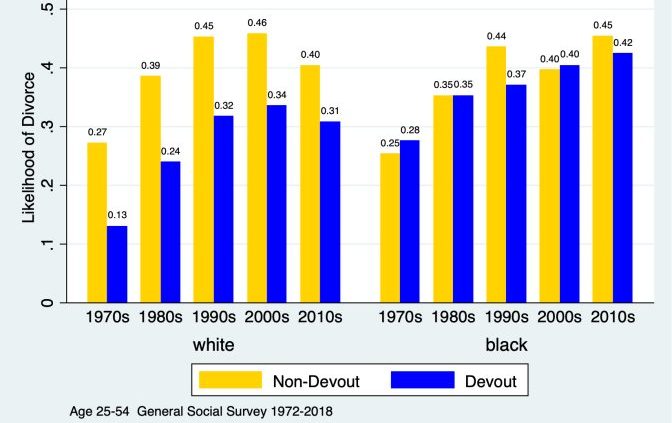
The article says:
The figure above shows that divorce rates are significantly lower for white Americans who attend church regularly and this difference remains significant across all decades.
A previous study out of Harvard University reached the same conclusion:
Considerable research over the last two decades has been devoted to the relationship between religious participation and health and well-being. Our research on this topic at the Harvard T.H. Chan School of Public Health links religious service attendance to a number of better health outcomes, including longer life, lower incidence of depression, and less suicide. Our work also indicates that religious service attendance is associated with greater marital stability—or more specifically, with a lower likelihood of divorce.1
We are not the first to study the relationship between religious service attendance and the likelihood of divorce. In fact, a number of studies have found similar results: namely, that those who attend religious services are about 30 to 50 percent less likely to divorce than those who do not.2
It’s really important for young people to make sure that the actions they take today are taking them towards the goal they want to reach tomorrow. Church attendance is good for marriage. Being debt-free is good for marriage. Being a virgin is good for marriage. If a young person wants a good marriage, then they need to choose the behaviors that make marriage work. And, just as important, they need to choose a spouse who also chooses the behaviors that make marriage work. Don’t rely on “feelings” and “intuitions” when you choose a spouse. Don’t be mystical. Look at the research on marriage, do the marriage best practices, and choose a spouse who also does the marriage best practices.
There’s no point in complaining about bad outcomes if you ignore the right way to get a good outcome.
 WINTERY KNIGHT
Yep, it is all about whether those identifying as Christians are devout or not.
It is sad but predictable how the allegedly pro-science crowd ignores all statistics about how to have successful marriages and how to raise good kids.
LikeLiked by 1 person