Greg Koukl and Michael Krueger discuss Bart Ehrman’s skepticism of the gospels

I have a key that will unlock a puzzling mystery

Here is a recent episode that I’m sure you’ll enjoy.

Details:

Michael Kruger on Bart Ehrman’s claim we can’t trust the  Gospel accounts (April 1, 2016)

The MP3 file is here.

Topics:

  • Who is Bart Ehrman? What are his books about?
  • Conservatives tend to agree with Ehrman on the facts, not on his interpretation of the facts
  • Ehrman has an article claiming that the Holy Week gospel accounts are untrustworthy
  • do the variants in the NT texts undermine the reliability of the texts?
  • the difference between reasonable scholar-Bart and hyper-skeptical popularizer-Bart
  • where does Ehrman’s view of gospel reliability fit in the broad spectrum of NT scholars?
  • there are 200,000 to 400,000 variants in the copies of the gospels: what is a “variant”?
  • can a person be an authentic Christian if the gospels are not actual historical events?
  • Ehrman’s view: Christians can have feelings about events that never happened = not Biblical
  • was Jesus just an itinerant preacher who spoke pithy slogans? what about his Jewish background?
  • is there scholarly agreement regarding the minimal facts underlying the resurrection of Jesus?
  • is there a disconnect between uneducated eyewitnesses and educated Greek gospel authors?
  • is the early church an “oral culture” or a “textual culture”? Is oral transmission reliable?
  • was text of the New Testament was inspired by God or dictated by God?
  • do we have any reasons to think that the gospel authors were in contact with eyewitnesses?
  • should be be hyper-skeptical of the gospels when we have an early creed in 1 Cor 15:3-8?

Stand to Reason does a nice job with their podcast. Not only can you download the MP3, but they have a transcript, and links to resources mentioned in each episode. First class!

Highlights from day one of the Masterpiece Cakeshop Supreme Court case

Kristen Waggoner of Alliance Defending Freedom argued Jack Phillips’ case before the Supreme Court. (Photo: Jeff Malet/The Heritage Foundation) Kristen Waggoner of Alliance Defending Freedom argued Jack Phillips’ case before the Supreme Court. (Photo: Jeff Malet/The Heritage Foundation)

I thought it might be worth reading about the first day of arguments in the Masterpiece Cakeshop case. Not only can we find out what is likely to happen, but we’ll also learn how the ADF lawyer Kristen Waggoner is making her defense.

The Daily Signal reports:

The Supreme Court heard oral arguments on Tuesday in a closely watched case dealing with free speech, religious liberty, and same-sex marriage.

Specifically, the justices considered whether the state of Colorado can force Jack Phillips, a Christian baker, to create a custom cake for a same-sex wedding against his deeply held religious beliefs.

Attorneys for Phillips clearly explained that he seeks to exercise his freedom only to speak messages that he agrees with, while still welcoming all customers into his store. The First Amendment’s free speech and religious liberty clauses protect his freedoms to do just that.

In a lengthy and charged oral argument, the nine justices wrestled with how Americans who hold different views on marriage in our post-Obergefell society can continue to live with each other in mutual respect.

Here is the key that might predict the outcome, from the Supreme Court’s swing vote:

In one of the most charged exchanges of the day, Justice Anthony M. Kennedy questioned Colorado Solicitor General Frederick Yarger about whether a member of the Colorado Civil Rights Commission who compared Phillips to a racist and a Nazi demonstrated anti-religious bias—and that, if he did so, whether the judgment against Masterpiece should stand.

More:

After disavowing the commissioner’s comments, Yarger argued that the ruling should still stand. But Kennedy returned to the issue again, telling Yarger that “tolerance is essential in a free society. And tolerance is most meaningful when it’s mutual. It seems to me that the state in its position here has been neither tolerant nor respectful of Mr. Phillips’ religious beliefs.”

Kennedy also pointed out there were other cake shops that would have accommodated Charlie Craig and David Mullins, the same-sex couple who requested a cake for their wedding.

In a similar line of questioning, Justice Samuel Alito pointed out that the state of Colorado had failed to demonstrate mutual tolerance when it only protected the freedom of cake artists who landed on one side of the gay marriage debate—namely, the state’s side.

When three religious customers went to cake artists to request cakes that were critical of same-sex marriage, those cake artists declined—yet Colorado did not apply its anti-discrimination statute to punish the artists. But when Phillips declined to create a cake to celebrate a same-sex marriage, Colorado imposed a three-pronged penalty that drove him out of the wedding cake business, causing him to lose 40 percent of his business.

[…]In the exchange with Alito, the Colorado solicitor general said that cake artists could not discriminate on the basis of identity, but could discriminate on the basis of messages. Gorsuch later responded, saying that’s exactly what Phillips has argued.

It was also made clear that Phillips was not discriminating against identity, but just refusing to agree with the state’s position on same-sex marriage.

During the oral arguments, the court appeared to recognize what is patently obvious from the facts. Phillips welcomes all people into his store, encourages them to buy off-the-shelf items, and will make custom-designed cakes for them provided they don’t ask for items that violate his beliefs.

He has served gays for the 24 years his store has been in operation and welcomes their business to this day. He does not discriminate against anybody because of their identity.

So comparisons to shopkeepers in the Jim Crow South who sought to keep the races “separate but equal” are a smear that divert attention from the real issue: Phillips simply disagrees with the state on the issue of marriage.

More:

Finally, the oral arguments revealed the scope of how far the state of Colorado is willing to go to impose its views of marriage on citizens. In one line of questioning from Roberts, Colorado admitted that it would force Catholic Legal Services to provide a same-sex couple with legal services related to their wedding even if it violates Catholic teachings on marriage.

And in questioning from Alito, the ACLU answered that the state could force a Christian college whose creed opposes same-sex marriage to perform a same-sex wedding in its chapel.

I was listening to the latest Ben Shapiro podcast, and in the last 10 minutes, he talked about the case. He pointed out that at the time when Phillips refused to participate in a same-sex marriage, same-sex marriage was not even legal in Colorado. Nevertheless, Colorado went after him. Hard. I think they secular left is going to lose this case – it’s just too much fascism. Too much intolerance.

You can read more about Kristen Waggoner here. She’s also arguing the Arlen’s Flowers v. the State of Washington case. A great lady. A real hero.

If you’re looking for a great book to read on what comes after same-sex marriage and how to discuss and debate it, read Ryan T. Anderon’s “Truth Overruled: The Future of Marriage and Religious Liberty“. It’s the best book for laymen on the subject. Really helps you to know how to talk about this issue. I had to do it a week ago with one of my atheist co-workers who asked ME out to lunch to talk more about his spiritual journey. If you don’t read, you can’t defend.

Supreme Court to decide whether it is legal to be a Christian after same-sex marriage

Masterpiece Cakes

I had a really tough decision Monday night about what to write about for Tuesday’s post. I wanted to say something about the sexting and resume misrepresentation accusations against Ravi Zacharias. I also wanted to say something about the how the Democrats in the DOJ and the FBI protected Hillary Clinton from criminal charges while inventing a fake Russia-Trump connection. I wanted to say something about how the Supreme Court just allowed full enforcement of the Trump security measures against countries that are significantly influenced by radical Islamic terrorism. In the end, I chose the Supreme Court story, because it relates to free speech and freedom of association

There’s a good little video summary of the case here:

Ben Shapiro posted a great summary of what you need to know about the case at the Daily Wire:

On Tuesday, the Supreme Court is slated to hear oral argument in the famed Masterpiece Cakeshop case. The case is a seminal one for religious liberty. It pits the ability of local and state governments to enforce “anti-discrimination law” against religious practice rights for businessowners; it essentially decides whether or not religious people can practice their religion in their business. This goes to the heart of freedom of religion in the United States.

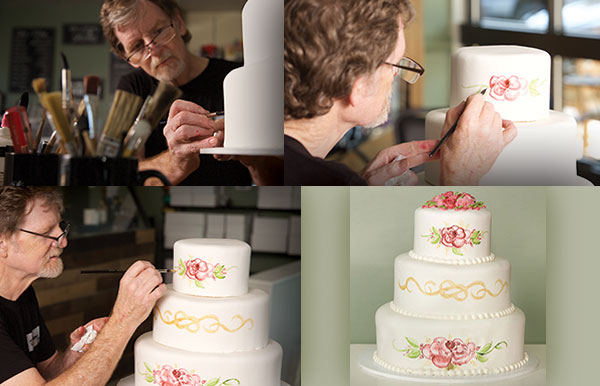
The case revolves around a man named Jack Phillips. Jack is a baker. He makes and decorates cakes. He has a simple rule: he’ll sell anyone a cake. Gay, straight, transgender, green. Anyone. But he won’t make a custom cake for every event. As a religious Christian, this means that he sees it as sinful participation to make a custom cake celebrating a same-sex wedding. So he’ll make a cake for a same-sex wedding, but he won’t decorate it as such (no groom-groom wedding toppers, for example). He also refuses to make cakes that push anti-gay messages, anti-American messages, and adult-themed messages.

That’s his Constitutional right. But the Leftists at the Colorado Civil Rights Commission didn’t think so. They think that Jack must be forced to violate his own religious beliefs and decorate a cake for a same-sex wedding, or stop making any cakes at all. As a result of their ruling, Jack lost 40% of his business and more than half of his employees — all for abiding by his Biblical beliefs in the most tolerant possible way. He was even told that he had to re-educate employees, including his family members, and report to the government what his artistic decisions were, listing all the cakes he’d failed to bake and why.

Now, I know lots of people who claim to be Christians who support redefining marriage to eliminate the requirement of complementary sexes. I wonder how they would explain their support for SSM given this clear case of fascism by a secular government? Before this country redefined marriage, people on the right warned that there would be consequences for religious liberty.

Sometimes, it’s nice to read what is really happening in the world, with the politically correct spin removed.

Try this:

But this isn’t a religious case at all. It’s a freedom of association and freedom of speech case. Religious practice shouldn’t be bound to the home or church — religious life infuses every aspect of living. But by the same token, an atheist should be free to reject a Christ-themed cake, a Leftist speechwriter should be free to reject a right-wing politician, and The New Republic should be free to refuse to deliver to the Trump White House. Does this mean that people we dislike will be able to act in ways we dislike? Absolutely. But freedom lives in the spaces where we acknowledge that we have no right to another’s labor or approval. Tyranny grows when we refuse to acknowledge those spaces.

What’s really going on here is that there is a group of people involved in sinful, self-destructive activities. And their response to their own bad feelings about what they’re freely choosing to do is to try to generate happy feelings by forcing everyone around them to celebrate their decisions. You would never see a chaste person suing unchaste people to demand their approval. That’s because chastity is self-evidently virtuous. No outside celebration or affirmation is wanted or needed. But sinful people become obsessed with shutting out purity. And if they can’t shut it out, then they use the law to stamp it out.

That’s what this Supreme Court case is really about. We shouldn’t make the mistake of thinking that people on the secular left are Americans in any sense of the word. They don’t accept the Constitution, they don’t accept free speech, they don’t accept freedom of association, they don’t accept religious liberty. They accept their sexual desires. And the human rights of everyone else in the world has to give way to their sexual desires.

The loss of liberty for Bible-believing Christians isn’t a problem for fake Christians who think Christianity is about feeling good and being liked. It’s only a problem for people who actually do have a relationship with God in Christ. And that’s a very small minority of people who profess Christianity.

For a more thorough take on the legal aspects of the case, you can check out this editorial by Robbie George in the radical leftist New York Times, of all places.