
Tag Archives: Grace

Is Christianity intended to provide you with health, wealth and happiness?

Bible study that hits the spot

Is Christianity supposed to provide you with health and wealth?

Consider post on the Gospel Coalition.

It says:

I am a pastor in a small village about 500 kilometers west of Nairobi—in Kenya’s sugar belt region. For the better part of my adult life, I was a Pentecostal/charismatic/Word of Faith preacher. But the day came when my faith made no sense at all.

I first heard the gospel as a young man, though the message contained false advertising about a Jesus who would meet all my needs and fulfill all my dreams. Remaining unsaved would lead to a life of misery, sickness, and poverty, I was told. It appeared logical, then, to embrace Christ and step into a world of limitless blessing.

I wanted all God had for me, and I zealously rose to become a herald of the message I had received—which I later learned is Word of Faith teaching some call the “prosperity gospel.” I knew of no other gospel. I believed God was good, and this meant nothing uncomfortable came from him.

I learned to deal with Satan for causing anything negative in my life. Spiritual warfare was ingrained in me. As part of the “God class,” as Word of Faith teachers say, I had absolute authority to create my own world through positive thinking and faith-based confessions.

I believed God’s will included health and wealth, which I could call into existence by faith. Anything less should be repudiated. If all else failed, I could engage the heavenly language of angels—praying in tongues—to bypass Satan and the hosts of darkness.

Do you believe any of that?

Well, the pastor goes on to explain all the terrible things that happened to him – and these are the most difficult experiences that can happen to anyone. How did he respond to God allowing all these bad things happening to him?

Well, pretty badly at first:

Without answers, we were dismayed with God, whose ways no longer made sense to us. Though faith became a mirage, we kept up appearances, trying to pretend we didn’t despair. Yet inwardly we felt doubtful, hopeless, even cursed.

How could we reconcile these bad things with a good God? Our Word of Faith teaching instructed us to dismiss Job’s suffering as a consequence of his negative confession: “The LORD gave, and the LORD has taken away” (Job 1:21). But how could we make sense of Paul himself falling sick (Gal. 4:13) and yet rejoicing in his afflictions (2 Cor. 12:10)? How could we continue to reconcile this portrait with modern “super-apostles” who market health and wealth in their books, DVDs, and mega-meetings?

In my faith crisis and anger at God, I vowed to quit the ministry. I felt like a fraud for preaching a “gospel” that did not work. God had become an enigma, and faith a labyrinth. Yet the passage of time and the routine activities of Churchianity soothed our restless minds—for a while.

But then this happened:

My friend asked me to translate in Swahili as Billy delivered a message in English. The topic, “justification by faith alone through the imputed righteousness of Christ,” sounded ridiculous to me. Onstage for one awkward hour, I forced myself to deliver words I believed were unbiblical and heretical. But the sovereign Lord worked in my heart, calling forth reason through an inner witness to the truths proclaimed. The Holy Spirit planted sufficient doubt about the system I’d defended.

Over the next three weeks I felt tortured by God for my errors, which became apparent with every Bible text I once thought supported my beliefs. The same verses now looked different, affirming Billy’s message.

[…]Though I didn’t understand the fine points of theology, my conversion was decisive. Enthralled by Christ, who bids his own to “take up his cross daily and follow me” (Luke 9:23), I now felt that “the sufferings of the present time are not worth comparing with the glory that is to be revealed to us” (Rom. 8:18).

I guess I should say the obvious – I have no idea how you would get the idea that you can coerce God into giving you health, wealth and prosperity. This is such an immature view of God. Anyone who has ever been involved in any kind of serious enterprise knows that the best people are the ones who stick to the mission through thick and thin, and just keep on fighting through the hunger, suffering, sickness and other setbacks. And that’s everywhere in the Bible. For goodness sake: Jesus was obedient to God to the point of suffering torture and giving his life as a sacrifice to save others from their rebellion against God. How do you get health, wealth and happiness from that?

But more than that, this makes me think of when I was young and first exposed to the Christian message. Far from being something that pushed me away from Christianity, the Bible’s message of suffering with honor, and doing the moral thing regardless of happy outcomes, really resonated with me. It is very real world. In this world, it is rare that doing the right thing works out for you. In fact, there should be some area of your life where you are missing something that you really want and need. Consider that a joy, because when you are poor and hungry sad and meek, that’s when you are most like the people in the Bible who had to experience these things while remaining faithful and obedient. For me, not being married and not being a father is my empty hole that will never be filled. I get asked about it a lot by my co-workers, and they know I am not happy about it, but they also know I am still faithful even if my needs are not met.

These are my two favorite passages in the Bible:

1 Corinthians 4:2:

1 This is how one should regard us, as servants of Christ and stewards of the mysteries of God.

2 Moreover, it is required of stewards that they be found faithful.

3 But with me it is a very small thing that I should be judged by you or by any human court. In fact, I do not even judge myself.

4 For I am not aware of anything against myself, but I am not thereby acquitted. It is the Lord who judges me.

Matthew 5:13:

10 “Blessed are those who have been persecuted for the sake of righteousness, for theirs is the kingdom of heaven.

11 “Blessed are you when people insult you and persecute you, and falsely say all kinds of evil against you because of Me.

12 Rejoice and be glad, for your reward in heaven is great; for in the same way they persecuted the prophets who were before you.

13 “You are the salt of the earth; but if the salt has become tasteless, how can it be made salty again? It is no longer good for anything, except to be thrown out and trampled under foot by men.

14 “You are the light of the world. A city set on a hill cannot be hidden;

15 nor does anyone light a lamp and put it under a basket, but on the lampstand, and it gives light to all who are in the house.

The Bible doesn’t shy away from suffering and evil. That’s part of the normal Christian life. And how you respond to lack and suffering and evil is a powerful signal to the watching world about what Christianity is all about.

From a practical point of view, I do recommend making good decisions to prepare for potential troubles and tragedies. If you are careful to make yourself defensible to unexpected setbacks, not only will you be able to endure them, but you will be strong to help others endure them, too. The goal is to not let go of God because unmet desires and dashed expectations. A wise person understands that everyone has a breaking point, but with a little wisdom and preparation, you can build your defenses so that the stress that might break someone less prepared does not break you.
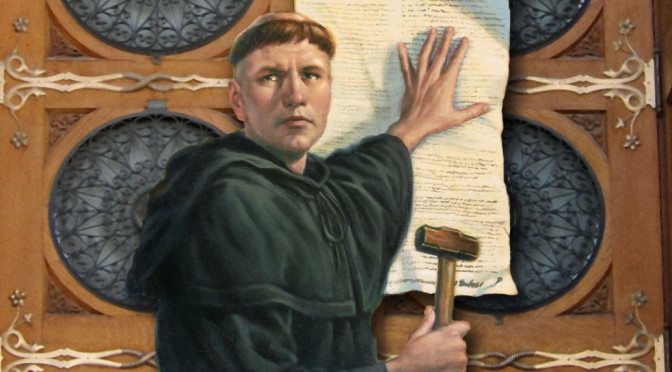
Reformation Day celebrates the supremacy of Scripture and reason in theology

Martin Luther defies the Roman Catholic hierarchy with his 95 Theses

The Ligonier Ministries web site has a summary of the event that kicked off the Reformation.

Excerpt:

On October 31, 1517, Martin Luther tacked up 95 theses on the church door at Wittenberg. With this act, he hoped to provoke a discussion among the scholars about the abuses of the indulgences by the Roman Catholic Church. He was not trying to create a public furor by any means, but within a fortnight, these theses had spread through the country like wildfire. The last thing Luther had in mind was to start some kind of major controversy, but nevertheless major controversy did begin.

From the discussions at Wittenberg, the disputations began to accelerate and escalate. Copies of the theses reached Rome and critical meetings were scheduled with the young monk. In these debates, Luther was maneuvered into proclaiming publicly that he had questions about the infallibility of church councils and also that he thought that it was possible that the pope could err. In 1520 a papal encyclical was issued which condemned Martin Luther as a heretic. Luther burned the document in a public bonfire and his defiance before the church was now a matter of record.

In response, Martin Luther picked up his pen to challenge the entire penitential system of the Roman Catholic Church, which undermined in principle the free remission of sins that is ours in the gospel. By doing so, he was unswervingly advocating his commitment to sola fide, the doctrine of justification by faith alone.

In 1521, Luther was summoned to the Imperial Diet, an authoritative meeting that involved the princes of the church, called by the Emperor of the Holy Roman Empire to be held in the city of Worms in Germany. Luther was an outlaw. For him to appear at the Diet was to risk his very life; therefore, he was given safe conduct by the Emperor to attend. With a few friends, Luther traveled from Wittenberg to Worms. The eyewitnesses of that episode tell us that when Luther’s little covered wagon appeared around the corner of the bend, there were lookouts posted in the church tower at Worms. All the people were agog waiting for the arrival of this notorious person. When Luther’s caravan was sighted, people were throwing their hats in the air, blowing trumpets, and creating all the fanfare of the arrival of the hero. It was the 16th century answer to a ticker-tape parade.

Things, however, became very solemn in a hurry because the next day he appeared before the Diet. His books were stacked on a table in the room, and he was asked and ordered to recant of his writings. This surprised Luther because he thought he was going to have an opportunity to defend his writings; but the only question really of any importance that was asked of him was this: “Are these your writings?” And when he said yes, they said, “Are you ready to recant of them?”

Hollywood has their version of Luther standing there boldly with his fist in the air saying, “Here I stand!” and so on. But instead he dropped his chin on his chest and muttered something that nobody could understand, so they asked him to speak up. “What did you say?” He said, “May I have 24 hours to think about it.” And so Luther was granted a reprieve of 24 hours to return to his room to contemplate the seriousness of this occasion.

The prayer that Luther wrote in that ensuing 24-hour period was one of the most moving prayers I have ever read in my life. In that prayer, Luther cried out for God in his sense of total loneliness fearing that God had abandoned him, and proclaimed, “O Lord, I am Thine, and the cause is Thine, give me the courage to stand.”

And on the morrow, Luther was called once again back to the court and was told to reply to the question. He said to the Diet, “Unless I am convinced by sacred Scripture or by evident reason, I cannot recant, for my conscience is held captive by the Word of God, and to act against conscience is neither right nor safe. Here I stand. I can do no other. God help me.” And with that there was an instant uproar.

The Protestant Reformation emphasizes the responsibility of each person to become familiar with what the Bible teaches for themselves and to make sense of it using the laws of logic for themselves. There is an enormous focus on the individual’s responsibility to puzzle theology out for himself, using the tools available to him: reason, science, Scripture, and history. When doing theology, Protestants do not accept the authority of someone who has a fancy title, fancy hat, fancy robe or fancy staff. Everyone is responsible to read the Bible, read systematic theology, consult history, and determine what the truth is based on evidence, not authority.

The Reformation put forward the famous five Solas: “Sola Scriptura” (Scripture Alone); “Sola Gratia” (Grace Alone); “Sola Fide” (Faith Alone); “Solus Christus” (Christ Alone); and “Soli Deo Gloria” (To God Alone Be Glory). The vertical relationship with God is seen as more important than making people feel good here and now. True beliefs about God are deemed to be more important than being a good social worker. And that’s why Jesus said that the most important commandment is to love God, then secondly, to love your neighbor. It’s important to get that in the right order, because true beliefs about God’s existence, God’s character, and God’s actions in history are the most important things.

The Reformation was the beginning of evangelical Protestantism, which is really the view that the Christian religion ought to be rooted in actual historical events that are documented in the Bible.

Is Christianity intended to provide you with health, wealth and happiness?

Bible study that hits the spot

I don’t have any friends who believe that Christianity is supposed to give them health, wealth and happiness. I mentor one girl from Africa, and she is always telling me that it is only Western Christians who think that suffering and evil is unexpected for Christians. Anyway, Lindsay shared this post about the so-called “prosperity gospel”, and so I am linking to it and excerpting something for me to comment on.

Here’s the post on the Gospel Coalition.

It says:

I am a pastor in a small village about 500 kilometers west of Nairobi—in Kenya’s sugar belt region. For the better part of my adult life, I was a Pentecostal/charismatic/Word of Faith preacher. But the day came when my faith made no sense at all.

I first heard the gospel as a young man, though the message contained false advertising about a Jesus who would meet all my needs and fulfill all my dreams. Remaining unsaved would lead to a life of misery, sickness, and poverty, I was told. It appeared logical, then, to embrace Christ and step into a world of limitless blessing.

I wanted all God had for me, and I zealously rose to become a herald of the message I had received—which I later learned is Word of Faith teaching some call the “prosperity gospel.” I knew of no other gospel. I believed God was good, and this meant nothing uncomfortable came from him.

I learned to deal with Satan for causing anything negative in my life. Spiritual warfare was ingrained in me. As part of the “God class,” as Word of Faith teachers say, I had absolute authority to create my own world through positive thinking and faith-based confessions.

I believed God’s will included health and wealth, which I could call into existence by faith. Anything less should be repudiated. If all else failed, I could engage the heavenly language of angels—praying in tongues—to bypass Satan and the hosts of darkness.

Do you believe any of that?

Well, the pastor goes on to explain all the terrible things that happened to him – and these are the most difficult experiences that can happen to anyone. How did he respond to God allowing all these bad things happening to him?

Well, pretty badly at first:

Without answers, we were dismayed with God, whose ways no longer made sense to us. Though faith became a mirage, we kept up appearances, trying to pretend we didn’t despair. Yet inwardly we felt doubtful, hopeless, even cursed.

How could we reconcile these bad things with a good God? Our Word of Faith teaching instructed us to dismiss Job’s suffering as a consequence of his negative confession: “The LORD gave, and the LORD has taken away” (Job 1:21). But how could we make sense of Paul himself falling sick (Gal. 4:13) and yet rejoicing in his afflictions (2 Cor. 12:10)? How could we continue to reconcile this portrait with modern “super-apostles” who market health and wealth in their books, DVDs, and mega-meetings?

In my faith crisis and anger at God, I vowed to quit the ministry. I felt like a fraud for preaching a “gospel” that did not work. God had become an enigma, and faith a labyrinth. Yet the passage of time and the routine activities of Churchianity soothed our restless minds—for a while.

But then this happened:

My friend asked me to translate in Swahili as Billy delivered a message in English. The topic, “justification by faith alone through the imputed righteousness of Christ,” sounded ridiculous to me. Onstage for one awkward hour, I forced myself to deliver words I believed were unbiblical and heretical. But the sovereign Lord worked in my heart, calling forth reason through an inner witness to the truths proclaimed. The Holy Spirit planted sufficient doubt about the system I’d defended.

Over the next three weeks I felt tortured by God for my errors, which became apparent with every Bible text I once thought supported my beliefs. The same verses now looked different, affirming Billy’s message.

[…]Though I didn’t understand the fine points of theology, my conversion was decisive. Enthralled by Christ, who bids his own to “take up his cross daily and follow me” (Luke 9:23), I now felt that “the sufferings of the present time are not worth comparing with the glory that is to be revealed to us” (Rom. 8:18).

I guess I should say the obvious – I have no idea how you would get the idea that you can coerce God into giving you health, wealth and prosperity. This is such an immature view of God. Anyone who has ever been involved in any kind of serious enterprise knows that the best people are the ones who stick to the mission through thick and thin, and just keep on fighting through the hunger, suffering, sickness and other setbacks. And that’s everywhere in the Bible. For goodness sake: Jesus was obedient to God to the point of suffering torture and giving his life as a sacrifice to save others from their rebellion against God. How do you get health, wealth and happiness from that?

But more than that, this makes me think of when I was young and first exposed to the Christian message. Far from being something that pushed me away from Christianity, the Bible’s message of suffering with honor, and doing the moral thing regardless of happy outcomes, really resonated with me. It is very real world. In this world, it is rare that doing the right thing works out for you. In fact, there should be some area of your life where you are missing something that you really want and need. Consider that a joy, because when you are poor and hungry sad and meek, that’s when you are most like the people in the Bible who had to experience these things while remaining faithful and obedient. For me, not being married and not being a father is my empty hole that will never be filled. I get asked about it a lot by my co-workers, and they know I am not happy about it, but they also know I am still faithful even if my needs are not met.

These are my two favorite passages in the Bible:

1 Corinthians 4:2:

1 This is how one should regard us, as servants of Christ and stewards of the mysteries of God.

2 Moreover, it is required of stewards that they be found faithful.

3 But with me it is a very small thing that I should be judged by you or by any human court. In fact, I do not even judge myself.

4 For I am not aware of anything against myself, but I am not thereby acquitted. It is the Lord who judges me.

Matthew 5:13:

10 “Blessed are those who have been persecuted for the sake of righteousness, for theirs is the kingdom of heaven.

11 “Blessed are you when people insult you and persecute you, and falsely say all kinds of evil against you because of Me.

12 Rejoice and be glad, for your reward in heaven is great; for in the same way they persecuted the prophets who were before you.

13 “You are the salt of the earth; but if the salt has become tasteless, how can it be made salty again? It is no longer good for anything, except to be thrown out and trampled under foot by men.

14 “You are the light of the world. A city set on a hill cannot be hidden;

15 nor does anyone light a lamp and put it under a basket, but on the lampstand, and it gives light to all who are in the house.

The Bible doesn’t shy away from suffering and evil. That’s part of the normal Christian life. And how you respond to lack and suffering and evil is a powerful signal to the watching world about what Christianity is all about. It’s not about feelings. It’s not about community. It’s not about impressing people with how much you know, or how accomplished you are, or how much stuff you have. It’s about putting truth above all, and learning obedience to God in Christ, no matter what happens to you.

From a practical point of view, I do recommend making good decisions so that you don’t experience unnecessary suffering, though. Be wise, but resolute. If you are careful to make yourself defensible to unexpected setbacks, not only will you be able to endure them, but you will be strong to help others endure them, too. The goal is to not let go of God because unmet desires and dashed expectations.