
Tag Archives: Danger

When I was a child, I read J.R.R. Tolkien’s “The Hobbit” and it changed my life

Since I mentioned “The Hobbit” in my biographical page at the top of the blog, I thought it might be worth explaining what I like about it. I still listen to my favorite chapter from it quite often before bed, to put me to sleep. If it doesn’t work, I listen to other chapters. But why choose that book? Well, because The Hobbit had a huge impact on me when I was growing up.

So, the first thing to say is that I didn’t grow up in a home with parents who had any plan for me. They were not involved in engineering me into anything. They just wanted good grades, and their method of getting that was yelling at me on report card day, then forgetting about school entirely, a few days later. As a result, I had to find my own morality and wisdom. The main things I read for that were the Bible, and later on, British literature, like Shakespeare and Spenser. But I’ll always remember the first “big” book that I ever read, and that was the “The Hobbit”.

The Cover

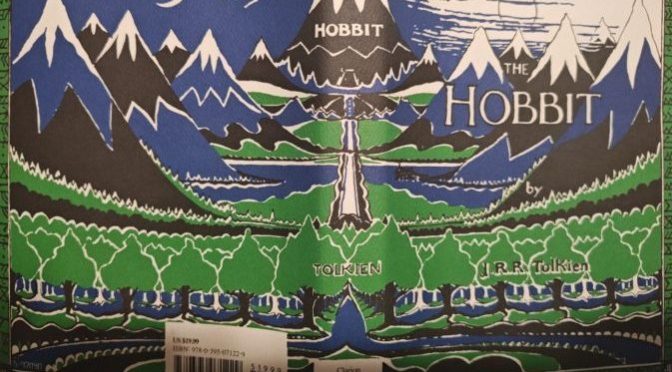
I noticed that there was a new printing of the book with the same cover design as the one that I read when I was small. I managed to get a gift copy of it from Desert Rose for my birthday. What I liked about the cover was the trees. If you look at the cover, there are multiple levels of trees, and you can see that the forest is deep, and you can’t see very far into it. I really liked that as a child. Somehow, that picture on the cover made me think about adventure, and then when I read the book, that really inspired me with the idea of going far away to earn my fortune. I remember that I didn’t read this book for school. I got it from the library.

My favorite chapter

My favorite chapter of “The Hobbit” is “Barrels Out of Bond”. That’s not the most popular chapter. But there is a phrase that appears in that chapter that’s also in the cover blurb from the first edition:

Bilbo Baggins was a hobbit who wanted to be left alone in quiet comfort. But the wizard Gandalf came along with a band of homeless dwarves. Soon Bilbo was drawn into their quest, facing evil orcs, savage wolves, giant spiders, and worse unknown dangers. Finally, it was Bilbo, alone and unaided, who had to confront the great dragon Smaug, the terror of an entire countryside

Did you notice that phrase, “alone and unaided”? I have it on my Twitter profile for my location. It comes from the “Barrels out of Bond” chapter.

So, let’s talk about the overall plot of the book. The plot is that a famous wizard named Gandalf asks Bilbo the hobbit to accompany a group of dwarves on an adventure. His job is to be the burglar, because hobbits are small and sneaky. They travel along until they reach a dark forest called Mirkwood. The dwarves are captured by the inhabitants of the forest – a band of wood elves. Bilbo is able to avoid capture, by slipping on his ring of invisibility that he found earlier. He follows the dwarves into the cave of the wood elves, because he doesn’t want to leave them behind. So, he gets stuck in the cave, wandering around, stealing food, and trying to keep from getting discovered and caught. All while trying to think about how to help the dwarves escape, and get on with their journey.

And then we find this passage:

“I am like a burglar that can’t get away, but must go on miserably burgling the same house day after day,” he thought. “This is the dreariest and dullest part of all this wretched, tiresome, uncomfortable adventure! I wish I was back in my hobbithole by my own warm fireside with the lamp shining!” He often wished, too, that he could get a message for help sent to the wizard, but that of course was quite impossible; and he soon realized that if anything was to be done, it would have to be done by Mr. Baggins, alone and unaided.

You can listen to the whole chapter here.

Bilbo isn’t your typical hero. He isn’t tall. He doesn’t have big muscles. He doesn’t beat up monsters because of his martial training. He doesn’t always know what to do. He sometimes makes mistakes. His strength is his character, especially his humility and selflessness. He isn’t motivated by the same selfish desires as many people are these days. He’s not motivated by greed. He’s not trying to impress anyone.

When I was small, it was important for me to be able to not fall into the traps of my environment. Finding out how to be different was important for me, because I was stuck in a home filled with negative talk and neglect, going to government schools, trapped in an socialist country. So, by reading books like the Hobbit, I was able to find virtues that were nowhere else in my environment.

More than the character was the idea of going on an adventure. That was one of the reasons why I left the country where I was born – so that I could come to America on a work permit, and seek my fortune. And keep seeking it, despite a lot of mistakes and setbacks. And not because outside people were leading me or helping me or engineering me to succeed. No family, no friends, no donations.

So the big lesson from the book  is that an adventurous spirit isn’t free – it has to be put into a boy by what he reads. You should make your children read “The Hobbit”. Put into their minds at a young age the idea that life is an adventure, that dangers and hardships are normal, and that character counts. Put into their minds that all goodness requires sacrifice. And to not worry so much about appearing important to other people.

On wargames, history and heroes: “this story shall the good man teach his son”

Last night I was reading Stephen Ambrose’s famous book “Pegasus Bridge: June 6, 1944”  after having watched an anti-communist movie “Guilty of Treason” (1950). I was thinking about how much I love to read about the bravery of people in the past. I also like to replay their battles, either on the computer or with board games. So I thought I would write about why I like to do that.

I play wargames, because I think that it is important to recognize and celebrate those who have demonstrated good character, whether it be now, or in the past. I think that it is important for us to search out the best role models ourselves, so that they will influence the way we act in our own lives. The second world war was a clear example of good versus evil. Anyone on the Allied side who demonstrated bravery and courage should be celebrated for safeguarding the security, liberty and prosperity that we enjoy today. In the case of Pegasus bridge, the hero is Major John Howard of the British paratroops.

Here is a quick re-cap of his exploits that day from the New York Times:

Maj. John Howard, the commander of glider-borne British infantrymen who seized the strategically vital Pegasus Bridge in the first battle of the D-Day invasion of Normandy, died Wednesday in a hospital in Surrey, England. He was 86 and had lived in Burford, near Oxford.

Under cover of night on June 6, 1944, six gliders carrying 181 officers and men of the Second Oxfordshire and Buckinghamshire Light Infantry landed on the eastern flank of a 60-mile invasion front on the northern coast of France. The regiment had a heritage going back to the battles of Bunker Hill and New Orleans, to Waterloo and to World War I. Now its soldiers were in the vanguard of the invasion of Hitler’s Europe.

Major Howard’s D Company was ordered to seize two bridges, one over the Caen Canal and the other spanning the parallel Orne River. If the Germans held on to those bridges, panzer units could move across them in a counterattack isolating 10,000 British paratroopers jumping behind the British invasion beach known as Sword, where infantry forces would arrive at daybreak. And Major Howard’s men sought to strike swiftly to prevent the Germans from blowing up the bridges if they were overwhelmed; the British needed those bridges to resupply their airborne units.

British Halifax bombers towed the gliders over the English Channel, then cut them loose.
Major Howard’s lead glider landed at 12:16 A.M., only 50 yards from the Caen Canal bridge, but the glider’s nose collapsed on impact, knocking everybody aboard unconscious for a few seconds. The soldiers quickly emerged, and over the next five minutes the men directly under Major Howard killed the surprised German defenders.

The nearby Orne River bridge was captured by other troops in Major Howard’s unit, and soon the words ”Ham and Jam,” signifying mission accomplished, were radioed to the airborne.

Two British soldiers were killed and 14 wounded in the operation.

Over the next 12 hours, British paratroopers and commandos reinforced Major Howard’s men, and British forces were able to move toward the city of Caen, their flank having been protected by the capture of the bridges.

On July 16, Major Howard received the Distinguished Service Order, Britain’s second-highest award for valor. On the 10th anniversary of D-Day, he received the Croix de Guerre Avec Palme from the French Government, which had renamed the Caen Canal span Pegasus Bridge, for the flying horse symbolizing the British airborne. The road crossing the bridge was later renamed Esplanade Major John Howard.

Why is this important? Well, it’s important to think on the things that are excellent. There are so many things in the culture that are not excellent that we are confronted with every day. We have to make it our business to do things together where goodness is celebrated. Especially when manly virtues like courage are celebrated. We don’t do that much anymore. And I think there’s a connection between wargames and Christian apologetics that we need to deliberately encourage.

Here’s an excellent passage from Shakespeare’s “Henry V” that makes the point:

This day is called the feast of Crispian:
He that outlives this day and comes safe home,
Will stand a tip-toe when this day is named,
And rouse him at the name of Crispian.
He that shall live this day, and see old age,
Will yearly on the vigil feast his neighbours,
And say, ‘To-morrow is Saint Crispian:’
Then will he strip his sleeve and show his scars,
And say, ‘These wounds I had on Crispin’s day.’
Old men forget: yet all shall be forgot,
But he’ll remember with advantages
What feats he did that day. Then shall our names,
Familiar in his mouth as household words,
Harry the King, Bedford and Exeter,
Warwick and Talbot, Salisbury and Gloucester,
Be in their flowing cups freshly remembered.
This story shall the good man teach his son;
And Crispin Crispian shall ne’er go by,
From this day to the ending of the world,
But we in it shall be rememberèd;
We few, we happy few, we band of brothers;
For he to-day that sheds his blood with me
Shall be my brother; be he ne’er so vile
This day shall gentle his condition:
And gentlemen in England, now a-bed
Shall think themselves accursed they were not here,
And hold their manhoods cheap whiles any speaks
That fought with us upon Saint Crispin’s day. (4.3.43)

This is from the famous speech in which King Henry charges his men to fight well before the famous Battle of Agincourt.

You can read more about the history of the British Airborne division and Pegasus bridge. The famous historian of the second world war Stephen E. Ambrose also wrote a history of the Pegasus bridge battle, called “Pegasus Bridge: June 6, 1944“. You won’t find many military historians better than Stephen E. Ambrose!

You might be surprised how many men are interested in military history and wargames, precisely because men instinctively look up to men like John Howard who embody qualities like bravery and courage. We have a dearth of moral character in this society. And we don’t do much to teach young men about manly virtues, even in the church. I think that it is important for us to think of creative ways for us to present good character to our young men.

Five things to learn from “The Hobbit”

Gabriel Belmont looks up at his destination: Dracula's castle
Gabriel Belmont looks up at his destination: Dracula’s castle (from Castlevania)

Since I mentioned “The Hobbit” in my biographical page at the top of the blog, I thought it might be worth linking to something about it.

This is from the Art of Manliness blog.

The 5 things:

  1. You can aspire to and achieve greatness no matter who you are and no matter your stage in life
  2. A great leader knows when it’s time to step back and let go
  3. There are some things in life we just have to accomplish on our own
  4. To simply continue on is one of the bravest things that can be done
  5. A great story always has conflict or hardship

And my favorite of the five – the one that had meaning for me – is #5:

5. A great story always has conflict or hardship. Imagine your life as a story. Not too long ago, we even had a guest post about this — our life is a journey, and a heroic one at that. Imagine yourself sitting down with your grandkids and telling them the story of you. “Well, I made some money, bought a few cars, sat around and watched TV for a few hours every night, and that’s about it.” Pretty boring, isn’t it? Now imagine that you can start hours worth of stories with, “I explored…I traveled…I fell in love…I fought and won…I overcame…I sweated…” Not only would the story be better, but you likely would be far more satisfied with the course of your life.

J.R.R. Tolkien agrees. “Now it is a strange thing, but things that are good to have and days that are good to spend are soon told about, and not much to listen to; palpitating, and even gruesome, may make a good tale, and take a deal of telling anyways.” He is saying that a life of good ease is a boring one. It’s often what the American dream aspires to, but the reality is that personal growth, and even enjoyment, are things that come out of some kind of challenge. Whether it’s huffing and puffing and groaning your way up a mountain for the view at the top, or getting laid off and finally realizing you don’t want to be in a cubicle anymore, joy is often found after a bit of trudging. Don’t shy away from challenge. Embrace it, and know that someday it’ll make for a great story.

The Hobbit was the first big book that I ever read as a child, and I think that it inspired me to move far away from home as soon as I completed graduate school, so I could make my fortune. An adventurous spirit isn’t free – it has to be put into a boy by what he reads. When I was young, I read “The Hobbit”. You should make your children read “The Hobbit”. Put into their minds at a young age the idea that life is an adventure, that dangers and hardships are normal, and that character counts. Put into their minds that all goodness requires sacrifice. I think that things are going to get harder for Christians going forward so it’s better that they be ready for it.