
Tag Archives: 101st Airborne

Remembering Lt. Richard Winters on D-Day: The Battle of Brecourt Manor

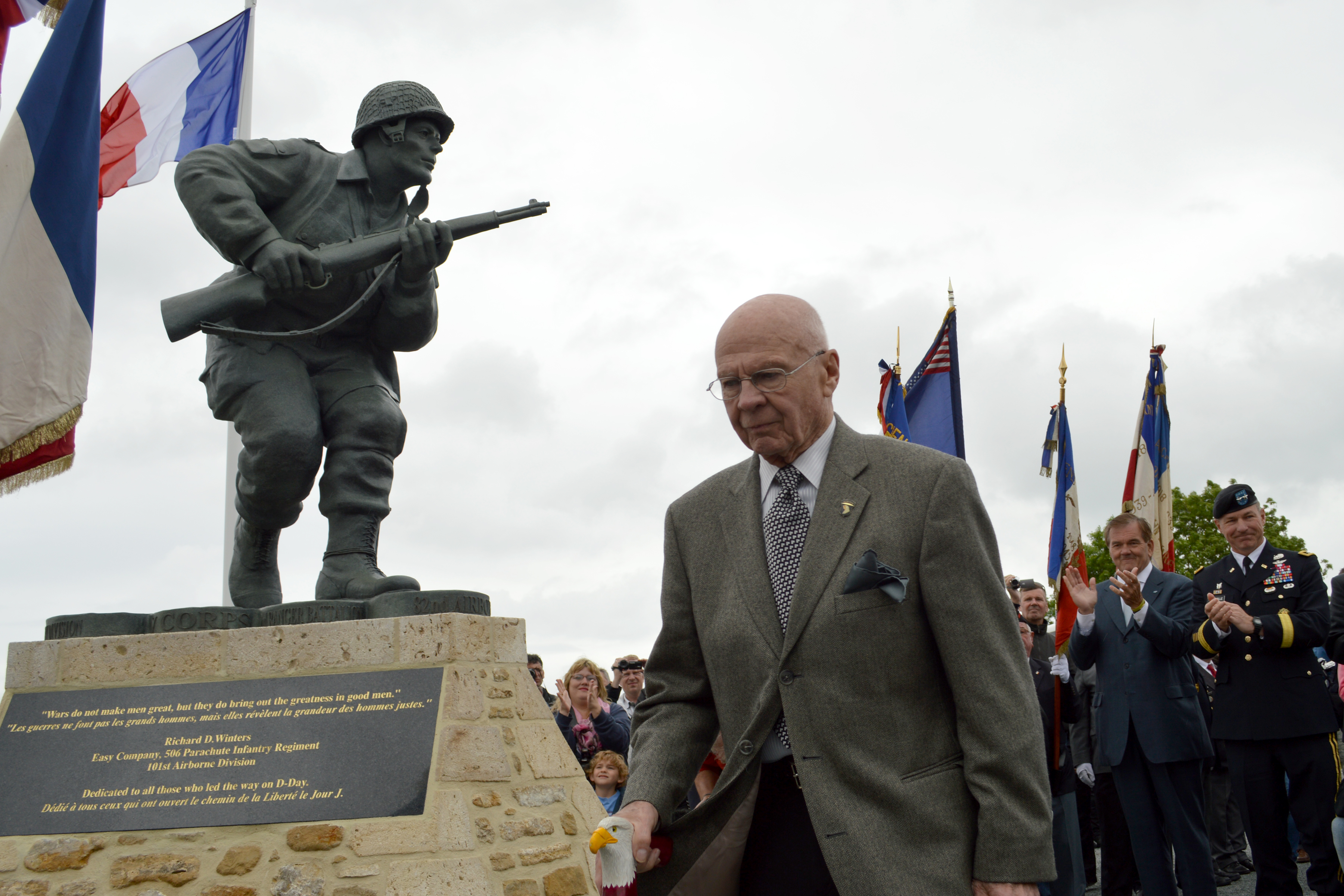
Richard D. Winters Monument

The caption says, “Wars do not make men great, but they do bring out the greatness in good men.” Now let’s see what Dick Winters did during World War II.

MIssion: locate and destroy artillery
Mission: locate and destroy enemy artillery

Brecourt Manor

I want to link to this article from Investors Business Daily about Lt. Winters action at Brecourt Manor.

Here’s the summary of what Dick Winters did on the morning of June 6th, 1944:

First Lt. Dick Winters leapt into leadership on D-Day, June 6, 1944. His commander’s aircraft was shot down as the men parachuted at 600 feet. When Winters headed to earth, he was in charge of a small platoon.

When he landed, he had to command Company E with 148 men, because his commander had been lost along with the plane.

Yet in the chaos, Winters could locate only a dozen other soldiers for their first task: take out a 50-man German artillery battery.

“Winters ordered his assault force to strip down to only essential weapons — guns and grenades — to use against the well-prepared defenses, then deployed his machine guns to cover his advances,” Keith Huxen, senior director of research at the National WWII Museum in New Orleans, told IBD. “Waiting for the proper moment, he led a charge across an open field, gaining the first gun placement, and then they moved down the trenches, systematically destroying each gun.

“In the process, Winters discovered a map detailing all German gun positions to kill American soldiers coming up from Utah Beach, which saved many lives.”

Joined by five reinforcements during the fight, Winters lost four dead and six wounded. The Yanks managed to kill 15 Nazis, capture 11 and wound many others.

Winters’ maneuvers are still studied at West Point as a case of successfully attacking a fixed position, despite being outnumbered.

Winters (1918-2011) was born in Ephrata, Pa., and the family moved to Lancaster when he was 8.

He later attributed his character and desire to go to church regularly to his mother.

Winters attended local Franklin & Marshall College and earned an economics degree with top honors in 1941. He enlisted in the Army in August to shorten his service time, rather than wait to be drafted if America was to join the war.

Here’s where everything was, and the Rangers attacked through the trenches containing the four guns, while being raked with fire from multiple MG42 heavy machine guns across the open field.
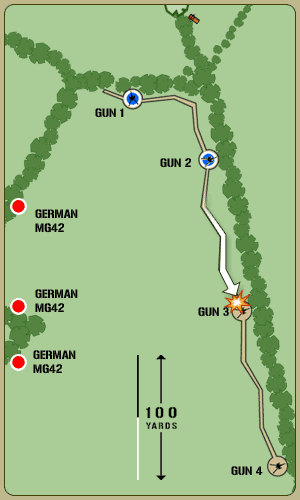
Assaulting the guns at Brecourt Manor

If this sounds familiar, it’s because he led one of the most famous actions in the Normandy invasion, and you may have seen it portrayed in the Band of Brothers DVD series.  But the article notes that when Dick Winters read the script, “he asked that the profanity be cut from the dialogue of his character, since he never swore”. When the producers told him it was too late to change it, he wrote them a letter of resignation from the production, because “I don’t want these boys and girls thinking it is acceptable using profanity”. In the end, the cleaned up his swearing.

If you are looking for a reason to buck the culture and stop swearing, there’s a good reason for you right there – Dick Winters never used profanity.

You can watch the scene from Band of Brothers in low resolution here:

If you play Combat Mission, like I do, you can watch a 28 minute AAR from the simulation of the battle.

The article talks about a lot of the actions that Winters participated in during World War II.

Operation Market Garden

More from the article, this time Operation Market Garden:

Near Nijmegen on Oct. 5, Winters’ platoon was a position where any movement carried risks. Rather than retreat when fired on by a larger force behind a dike, he led a charge to the top and on the other side discovered a company of 150 Nazi SS troops. Despite having only 40 men, the Americans opened up with everything they had, then shot up a company of enemy reinforcements.

The fray ended with 50 Germans dead, 11 POWs and countless wounded, with few casualties among the Americans.

“This was Easy Company’s crowning achievement of the war and my apogee as a company commander,” Winters told Kingseed. “This demonstrated its overall superiority, of every soldier, of every phase of infantry tactics: patrol, defense, attack using a base of fire, withdrawal and, above all, superior marksmanship with rifles, machine guns and mortar fire.”

Dick Winters is a brave man, someone I admire him very much. And I am grateful for men like him.

I blogged about another hero of the 101st Airborne Division, Ronald Speirs, in a previous post.

Courage under fire: Ronald Speirs and Easy Company at the Battle of Foy

I  try to occasionally post something that shows a particularly brave action from some time and place in military history. For example, I previously wrote about Medal of Honor winner Michael Murphy in 2011. Last year, his story was told more widely in the movie “Lone Survivor”, which I recommend to everyone. Today I want to highlight another hero: Ronald Speirs.

It is January 1945 and the famous “Screaming Eagles”, the 101st Airborne division, are about to turn the tide of the Battle of the Bulge in Bastogne.

Let’s read about the Battle of Foy courtesy of a scenario description from the wargame “Flames of War”. (Note: LMG = light machine gun, in this case, a .30 caliber machine gun)

Excerpt:

E or ‘Easy’ Company, 2nd Battalion, 506th Parachute Infantry Regiment, 101st Airborne Division, like the rest of the division, was ordered on to the attack on 9 January 1945 as part of a general offensive to drive back the Germans from Bastogne. In the following days the 506th Regiment, along with the 501st Parachute Infantry Regiment, cleared the forests around the town of Foy and pushed the Germans out. Their next objective was to take Foy to allow the 11th Armored Division to attack from Foy across the fields northeast towards Noville.

[…]At 0900 hours on 13 January Easy Company attacked along the western edge of Foy, along the road. The new year had brought heavy snow and the it blanketed the ground and had reduced temperatures to well below zero. 2nd Battalion commander, Captain Dick Winters, had two section of LMGs deployed on the edge of the woods facing Foy to give Easy Company covering fire while they crossed the 250 yards of open field between the forest and Foy’s buildings. There were just a few scattered trees and haystacks to give cover. As Easy Company advance the covering fire did its job, limiting the fire on the paratroopers to sporadic rifle shots. The approach on Foy made good pace under the cover of the LMG fire, but about 75 yards out from the edge of the village the skirmish line halted and the paratroopers hunkered down in the snow. Captain Winters stared in disbelief, wondering what was going on.

Lieutenant Dike, who was commanding Easy Company, had been overwhelmed with indecision. It became obvious to Winters that Dike didn’t know what he was doing, or had had a failure of confidence. His immediate impulse was to take command himself, but he noticed Lieutenant Ronald Speirs, a capable platoon commander from D Company, standing nearby. Winters ordered Speirs to take command of Easy Company and get the attack moving again. What Speirs did next amazed many of the paratroopers who witnessed it.

On receiving his orders from Winters, Speirs immediately ran at full speed down to where Dike and his HQ had taken cover behind a haystack and told Dike his orders, ‘I’m here to take over’. After quickly being told of the situation by the NCOs he ran off towards Foy. The men of Easy Company immediately followed. On reaching the outskirt buildings of Foy, Speirs immediately sought to link up with I Company of 3rd Battalion who, despite only having 25 men, were supporting the attack from the other flank of Foy. He set off running again, through the German lines, to find I Company’s commander. After consulting with its commander, Captain Gene Brown, he turned around and dashed back through Foy and the surprised Germans. Through all this the enemy fired on him with machine-guns, rifles and guns, but not a single shot hit its mark.

Now with all that said, watch the two clips below, and pay close attention the faces of the men under Lieutenant Dike, and then later under Lieutenant Speirs. Pay close attention to how Speirs’ courage inspires the men under him to also be courageous. Especially First Sergeant Lipton, who later risks his own life to draw fire from a German sniper so that Shifty Powers can prevent any other troops from being killed by the sniper.

The two clips are from “Band of Brothers”, the episode entitled “The Breaking Point“. There is some coarse language, but no sexual language in it. Really, if you are squeamish, do not watch it. However, if you can handle it, then buy the whole DVD set. It will inspire you, and help you to do things that you didn’t think were possible. If you really want to understand the men of E Company, you can read a book by Stephen E. Ambrose called Band of Brothers: E Company, 506th Regiment, 101st Airborne from Normandy to Hitler’s Eagle’s Nest (New York, 1992).

Low resolution clip, includes briefing at the beginning

This video is lower resolution, but show Winters reflecting on how Lipton had asked him not to let Dike lead the attack the night before, and also Winters carefully explaining to Dike that the American attack has to keep moving or they will get pinned down by machine guns and zeroed-in by mortars and destroyed.

I like that one because it shows the briefing, but the next clip is in 720HD.

High resolution clip, does not include briefing

This is a higher resolution version that is only 8.5 minutes long, but doesn’t have the briefing.

If you listen closely when Speirs explains what everyone is going to do, you can here one of the NCOs say “thank God” as he pats the other on the back.

Leadership

To be a good military leader, you have to know many things. A knowledge of strategy and tactics, a knowledge of military history, the ability to see the battlefield, knowledge of your opponent, knowledge of weapons, and so on. But surely the greatest of these is courage. As Von Clausewitz says in his famous book “On War”, “War is the province of danger, and therefore courage above all things is the first quality of a warrior.” Nothing inspires troops like a commander who is willing to take on the same risks that he asks his troops to take.

Take a look at this article from the Ivey School of Business journal, which talks about the characteristics of Canadian generals in Afghanistan.

Excerpt:

A leader must be in front of subordinates.  This takes courage.  Leadership from the front encapsulates the adage, never ask a subordinate to do something that you, the leader, wouldn’t do.  In Afghanistan, the leader must not only be in front, but he or she must be seen to be in front.  Subordinates seek this reassurance from their leaders at all levels.  Though they may be tentative, leaders must demonstrate character and moral strength.  Their credibility is inextricably dependent on their ability to do so..  During his frequent visits to Afghanistan, former Chief of Defence Staff (CDS), General Rick Hillier, made a point of visiting troops that were situated in some of the most IED-laden areas of the Canadian sector.  Through his demonstrated courage, he inspired leaders of all levels.  “If the CDS goes there, so can I” was the resulting mindset.  The current CDS, General Walt Natynczyk, has successfully continued this practice.

[…]All leaders need courage. It is the lynchpin of effective leadership.  No one respects a wimp who will buy in to any idea no matter how inane it might be.  Courage is having the strength of character to persist and hold on to ideas in the face of opposition.  Here, I’m not restricting my treatment of courage as it relates to fear.  It’s also about strength of character and devotion to causes and ideas.

As Christians, we have a leader who led by example. We all need to learn to not be so concerned with looking out for ourselves and our happiness first, but to instead be willing to take risks and sacrifice ourselves to do the right thing. We Christians should all be courageous, because we are led by a courageous leader.

That doesn’t necessarily mean going halfway across the world, it can mean reaching out to someone right there next to you who needs your help and support. Maybe that person has been running on an empty tank for a long time, but still trying to do the right thing. You never know when the opportunity to do something amazing will arise, but you won’t take it if you keep thinking of how you might get hurt. You have to reconcile yourself that you are not here to avoid every possible kind of suffering. It doesn’t mean that you take unnecessary risks, but it does mean not letting fear stop you from doing the right thing.

Now get out there and take that attack on in.

Courage under fire: Ronald Speirs and Easy Company at the Battle of Foy

I  try to occasionally post something that shows a particularly brave action from some time and place in military history. For example, I previously wrote about Medal of Honor winner Michael Murphy in 2011. Last year, his story was told more widely in the movie “Lone Survivor”, which I recommend to everyone. Today I want to highlight another hero: Ronald Speirs.

It is January 1945 and the famous “Screaming Eagles”, the 101st Airborne division, are about to turn the tide of the Battle of the Bulge in Bastogne.

Let’s read about the Battle of Foy courtesy of a scenario description from the wargame “Flames of War”. (Note: LMG = light machine gun, in this case, a .30 caliber machine gun)

Excerpt:

E or ‘Easy’ Company, 2nd Battalion, 506th Parachute Infantry Regiment, 101st Airborne Division, like the rest of the division, was ordered on to the attack on 9 January 1945 as part of a general offensive to drive back the Germans from Bastogne. In the following days the 506th Regiment, along with the 501st Parachute Infantry Regiment, cleared the forests around the town of Foy and pushed the Germans out. Their next objective was to take Foy to allow the 11th Armored Division to attack from Foy across the fields northeast towards Noville.

[…]At 0900 hours on 13 January Easy Company attacked along the western edge of Foy, along the road. The new year had brought heavy snow and the it blanketed the ground and had reduced temperatures to well below zero. 2nd Battalion commander, Captain Dick Winters, had two section of LMGs deployed on the edge of the woods facing Foy to give Easy Company covering fire while they crossed the 250 yards of open field between the forest and Foy’s buildings. There were just a few scattered trees and haystacks to give cover. As Easy Company advance the covering fire did its job, limiting the fire on the paratroopers to sporadic rifle shots. The approach on Foy made good pace under the cover of the LMG fire, but about 75 yards out from the edge of the village the skirmish line halted and the paratroopers hunkered down in the snow. Captain Winters stared in disbelief, wondering what was going on.

Lieutenant Dike, who was commanding Easy Company, had been overwhelmed with indecision. It became obvious to Winters that Dike didn’t know what he was doing, or had had a failure of confidence. His immediate impulse was to take command himself, but he noticed Lieutenant Ronald Speirs, a capable platoon commander from D Company, standing nearby. Winters ordered Speirs to take command of Easy Company and get the attack moving again. What Speirs did next amazed many of the paratroopers who witnessed it.

On receiving his orders from Winters, Speirs immediately ran at full speed down to where Dike and his HQ had taken cover behind a haystack and told Dike his orders, ‘I’m here to take over’. After quickly being told of the situation by the NCOs he ran off towards Foy. The men of Easy Company immediately followed. On reaching the outskirt buildings of Foy, Speirs immediately sought to link up with I Company of 3rd Battalion who, despite only having 25 men, were supporting the attack from the other flank of Foy. He set off running again, through the German lines, to find I Company’s commander. After consulting with its commander, Captain Gene Brown, he turned around and dashed back through Foy and the surprised Germans. Through all this the enemy fired on him with machine-guns, rifles and guns, but not a single shot hit its mark.

Now with all that said, watch the two clips below, and pay close attention the faces of the men under Lieutenant Dike, and then later under Lieutenant Speirs. Pay close attention to how Speirs’ courage inspires the men under him to also be courageous. Especially First Sergeant Lipton, who later risks his own life to draw fire from a German sniper so that Shifty Powers can prevent any other troops from being killed by the sniper.

The two clips are from “Band of Brothers”, the episode entitled “The Breaking Point“. There is some coarse language, but no sexual language in it. Really, if you are squeamish, do not watch it. However, if you can handle it, then buy the whole DVD set. It will inspire you, and help you to do things that you didn’t think were possible. If you really want to understand the men of E Company, you can read a book by Stephen E. Ambrose called Band of Brothers: E Company, 506th Regiment, 101st Airborne from Normandy to Hitler’s Eagle’s Nest (New York, 1992).

Low resolution clip, includes briefing at the beginning

This video is lower resolution, but show Winters reflecting on how Lipton had asked him not to let Dike lead the attack the night before, and also Winters carefully explaining to Dike that the American attack has to keep moving or they will get pinned down by machine guns and zeroed-in by mortars and destroyed.

I like that one because it shows the briefing, but the next clip is in 720HD.

High resolution clip, does not include briefing

This is a higher resolution version that is only 8.5 minutes long, but doesn’t have the briefing.

If you listen closely when Speirs explains what everyone is going to do, you can here one of the NCOs say “thank God” as he pats the other on the back.

Leadership

To be a good military leader, you have to know many things. A knowledge of strategy and tactics, a knowledge of military history, the ability to see the battlefield, knowledge of your opponent, knowledge of weapons, and so on. But surely the greatest of these is courage. As Von Clausewitz says in his famous book “On War”, “War is the province of danger, and therefore courage above all things is the first quality of a warrior.” Nothing inspires troops like a commander who is willing to take on the same risks that he asks his troops to take.

Take a look at this article from the Ivey School of Business journal, which talks about the characteristics of Canadian generals in Afghanistan.

Excerpt:

A leader must be in front of subordinates.  This takes courage.  Leadership from the front encapsulates the adage, never ask a subordinate to do something that you, the leader, wouldn’t do.  In Afghanistan, the leader must not only be in front, but he or she must be seen to be in front.  Subordinates seek this reassurance from their leaders at all levels.  Though they may be tentative, leaders must demonstrate character and moral strength.  Their credibility is inextricably dependent on their ability to do so..  During his frequent visits to Afghanistan, former Chief of Defence Staff (CDS), General Rick Hillier, made a point of visiting troops that were situated in some of the most IED-laden areas of the Canadian sector.  Through his demonstrated courage, he inspired leaders of all levels.  “If the CDS goes there, so can I” was the resulting mindset.  The current CDS, General Walt Natynczyk, has successfully continued this practice.

[…]All leaders need courage. It is the lynchpin of effective leadership.  No one respects a wimp who will buy in to any idea no matter how inane it might be.  Courage is having the strength of character to persist and hold on to ideas in the face of opposition.  Here, I’m not restricting my treatment of courage as it relates to fear.  It’s also about strength of character and devotion to causes and ideas.

As Christians, we have a leader who led by example. We all need to learn to not be so concerned with looking out for ourselves and our happiness first, but to instead be willing to take risks and sacrifice ourselves to do the right thing. We Christians should all be courageous, because we are led by a courageous leader.

That doesn’t necessarily mean going halfway across the world, it can mean reaching out to someone right there next to you who needs your help and support. Maybe that person has been running on an empty tank for a long time, but still trying to do the right thing. You never know when the opportunity to do something amazing will arise, but you won’t take it if you keep thinking of how you might get hurt. You have to reconcile yourself that you are not here to avoid every possible kind of suffering. It doesn’t mean that you take unnecessary risks, but it does mean not letting fear stop you from doing the right thing.

Now get out there and take that attack on in.