Category Archives: Commentary

Can a person be a Christian and yet still do bad things?

I sometimes write posts about atheists and say that they will have difficulty grounding the minimal requirements of morality if the universe is an accident and they are just lumps of matter. To show how this works out, I like to cite famous atheists who also managed to get political power, and then point out how they treated other people. I then say that doing bad things is not really wrong on atheism, since morality is really based on doing whatever you feel like that makes you feel good and that your peers will approve of. And if you want to do something they won’t approve of, you can still do it, as long as no one ever finds out.

Atheist readers sometimes object that Christians can behave just as badly as atheists.

But consider this post from Retha’s English-language blog. (She’s from South Africa)

Excerpt:

However you choose to define Christian, the definition most certainly is not “anyone who calls himself a Christian, is a Christian.” We don’t use that definition for anything else. We don’t believe that everyone who calls themselves “honest” are. We don’t believe that everyone who calls themselves “not overweight” are not. You cannot be a king, or a genius, or a dog, or a tall person, by calling yourself that. (If it worked that way, it would have been a very strong temptation to call myself drop-dead gorgeous.)

Simple word etymology is more useful: Christian has the root word Christ and the suffix –ian. A Christian is a Christ-following/ Christ-imitating person. Who is meant when we speak of Christ? He is the Jesus described in the New Testament, as described there.To be a Christ-ian, you need to follow/ imitate Jesus as he is painted in the Bible. That is where He is painted as the Christ.

There’s a lot of wisdom in those two paragraphs.

I think it’s possible for someone to call himself a Christian and yet to do bad things. Christians aren’t perfect. Even when they know what they ought to do, they struggle to do it. The dividing line here is that a real Christian is never going to call sin anything other than sin. They aren’t going to try to defend it. (Although I always try to explain what leads me to sin if anyone asks – which is not the same as rationalizing, it’s just explaining). Someone who claims to be a Christian and yet does things that Bible forbids without any shame or regret is not a Christian. If that person responds to being judged by denying that what they are doing is wrong, or by attacking the Bible’s authority on moral issues, then that person is not a Christian.

If the person is saying “don’t judge me”, or “the Bible doesn’t say that”, or “the Bible was written by men“, or “the Bible was written a long time ago”, or “I believe in a God of love”, or “you’re intolerant”, or “I was born as a pickpocket”, or “I have the bank-robbing gene”, or “that’s your truth”, or “that’s just your interpretation”, or “if God loved me, he would give me a Mercedez Benz”, then you are probably not dealing with a Christian, whatever they claim to be. Lots of people claim to be Christians but don’t follow Christ. An we shouldn’t believe that someone who tries to argue that abortion is consistent with the Bible is an authentic Christian, for example. The Bible forbids pre-marital sex and murder.

I sometimes struggle with going to church, because I can’t stand being around happy, singing people (unless they know apologetics, in which case I can). But you would never hear me say that going to church was wrong, or that I was morally justified in avoiding church. Instead, I would say I was wrong not to go to church regularly, but that I hadn’t found a church that made me feel comfortable yet.
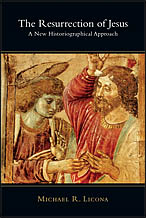
Why we work: to buy Mike Licona’s new resurrection book

Mike's new book on the resurrection

And what a big book it is! 718 pages!

Here are the details from Brian Auten:

Michael Licona, Research Professor of New Testament at Southern Evangelical Seminary, has just released a monumental new book: The Resurrection of Jesus: A New Historiographical Approach.

From the publisher:

Could there be any new and promising approach to the question of the historicity of Jesus’ resurrection? Yes, answers Michael Licona. And he convincingly points us to a significant deficiency in approaching this question: our historiographical orientation and practice. He then carefully and effectively applies his principles and methods to the question of Jesus’ resurrection.

This book is sure to become required reading for anyone exploring this field, as Michael Licona has made an extremely significant contribution to scholarship in this area.

Pick it up today.

The book is $27 dollars on Amazon, but you probably won’t need another book on the resurrection. I try not to buy books by people who haven’t debated anyone on the other side, but that won’t be a problem with Licona. He’s debated everybody on the other side – like Bart Ehrman, Richard Carrier and Shabir Ally. He’s battle-tested.

I took a look at the endorsements, and I recognize tons of historians.

Here’s one:

“Licona has tackled his subject energetically, with near-obsessive thoroughness. He concludes that if one approaches the sources without an a priori commitment to the impossibility of resurrection, the ‘Resurrection Hypothesis’ is the interpretation that most adequately accounts for the evidence. Thus, the book boldly challenges the naturalistic presuppositions of post-Enlightenment historical criticism. At the very least, Licona has shown that the usual naturalistic explanations of the resurrection tradition are, on the whole, weak, speculative and often tendentious. “I am not aware of any scholar who has previously offered such a thorough and fair-minded account of the historiographical prolegomena to the resurrection question. Furthermore, Licona’s discussion of the ‘bedrock’ historical evidence is appropriately nuanced and carefully modulated, not claiming more than can be supported by the consensus findings of qualified scholars. This lends credibility to his conclusions. Licona has presented a fair and vigorous case for his position. No doubt many readers will be unconvinced by his arguments, but no one can accuse him of naivet? or of ignoring counterarguments. “This study spans fields that are too rarely brought into conversation: New Testament studies and historiographical theory. Licona is to be commended for this undertaking and for producing a study that has both wide range and significant depth.”

—Richard B. Hays, George Washington Ivey Professor of New Testament and dean, Duke Divinity School

If you’re looking for a book on the resurrection, this might be a good one. Seems like it will cover everything.

UPDATE: Wow, big Mike Licona post up at Reason to Stand. Lots of Mike Licona videos.

Saskatchewan planning to abolish its Human Rights Tribunal

Political Map of Canada

Wow. I am speechless over this good news.

The Saskatchewan Leader-Post reports on the conservative Saskatchewan Party’s plan to introduce a bill to abolish the Human Rights Tribunal and replace it with non-kangaroo courts. (H/T Small Dead Animals via ECM)

Excerpt:

The provincial government plans to introduce human rights legislation that will dissolve the Saskatchewan Human Rights Tribunal in favour of having a court hear the complaints.

Justice Minister Don Morgan said the change, among other reforms to the Human Rights Code, is being undertaken at the suggestion of Judge David Arnot, chief commissioner of the Saskatchewan Human Rights Commission. The commission is the body that receives human rights complaints and occasionally refers a matter to a tribunal for a hearing.

“There seemed to be a lot of support for going forward with it so we felt it was an appropriate piece of legislation to bring at this time,” said Morgan, whose Sask. Party government signalled its intent in the throne speech to move forward with changes, which were first discussed in the spring.

“It will allow for a more streamlined process, more mediation and more expedited handling of files. But the most significant thing is it will no longer be the human rights tribunal. The complaints, when they’re referred on, will go directly to the Court of Queen’s Bench,” Morgan said.

The only problem with Saskatchewan now is that it’s really cold there, and Kate McMillan’s beloved Roughriders aren’t doing too well right now.

UPDATE: Here is a quick introduction to the Human Rights Commissions and Human Rights Tribunals.

That’s Ezra Levant, a Jewish conservative who is the King of free speech in Canada.

Related posts