Category Archives: Commentary

What does the concept of resurrection mean to Jewish theologians?

Here’s a helpful post from Eric Chabot talks about this and other interesting topics related to the resurrection.

Excerpt:

Where do we see resurrection in the Hebrew Bible?

As just stated, belief in a resurrection of persons from the dead are seen in eight passages: (Job 19:26; Ps. 17:15; 49:15; 73:24; Is. 26:19; 53:10; Dn. 12:2;12:13). The resurrection terminology is seen in two places (Ezek. 37:1-14; Hos. 6:2) to show a national and spiritual restoration brought about by the return from the exile. As far as the nature of the future bodily resurrection, it may involve a corpse or the receipt of a material body comparable to the present physical body (Job 19:26; Is. 26:19), or it may be a matter of transformation (Dn. 12:2-3 and perhaps 12:13); or glorification after reanimation, in the case of the righteous.

As far as the function of the resurrection, it may be personal vindication (Is. 26:16; 53:10-12). Resurrection may also have a function in relation to reward or punishment (Dn. 12:2; 12:13), an assumption to heaven and enriched fellowship with God (Ps. 49:15; 73:24,26), or preface to the beatific vision of God (Ps. 17:15 and possibly Job 19:26). (1)

The Greek word for resurrection is “anatasis” which means “a raising up” or “rising.” There are resuscitations in the Tanakh such as the example of Elijah and Elisha raising a person from death (1 Kings 17-23; 2 Kings 4:34-35). While these figures may have been raised in a resurrection sense, they were not raised immortal in the same way Jesus was.

Extra-Biblical Passages on Resurrection

There are also extra-biblical passages that speak about the resurrection (Enoch 92:2; 4 Ezra 7:32; Enoch 91:10; 2 Maccabees 7:9; 14; 28-29). Even the The Messiah Apocalypse, which is dated between 100 and 80 B.C.E mentions resurrection: “He [God] frees the captives, makes the blind see, and makes the bent over stand straight…for he will heal the sick, revive the dead, and give good news to the humble and the poor he will satisfy, the abandoned he will lead, and the hungry he will make rich.” (2)

In the Rabbinical literature there are explicit teachings on the resurrection. It says in the Mishnah 10.1, it says, “All Israelites have a share in the world to come; … and these are they that have no share in the world to come: he that says that there is no resurrection of the dead prescribed in the Law.” Moses Maimonides, a Jewish rabbi and a medieval Jewish philosopher who has forever influenced the Jewish and non-Jewish world said:

” The resurrection of the dead is one of the cardinal principles established by Moses our teacher. A person who does not believe this principle has no real religion, certainly not Judaism. However, resurrection is for the righteous. This is the earning of the statement in Breshit Rabbah, which declares: “the creative power of rain is both for the righteous and the wicked, but the resurrection of the dead is only for the righteous.” Our sages taught the wicked are called dead even when they are still alive; the righteous are alive even when they are dead” (Bab. Talmud Brakhot 18 b).

3 points are made here: 1. Resurrection is a cardinal principle taught in the Torah which all Jews must believe 2. It is for the righteous alone 3. All men must die and their bodies decompose. (3)

It’s important to understand that the concept of resurrection had a meaning before Christianity ever started. And it’s interesting to ask why the early Christians applied the notion of resurrection to Jesus. What is the best explanation for their decision to do such a strange thing? Why not just give up on him and deny that he was the Messiah when he was killed by the Romans?
Dennis Prager: does the Bible say do not kill or do not murder?

Dennis Prager’s column on the sixth commandment.

Excerpt:

Here is the text of commandment six — explaining why the King James translation is wrong:

You would think that of all the Ten Commandments the one that needs the least explaining is the sixth, because it seems so clear. It is the one that the King James Bible, the most widely used English translation of the Bible, translates as, “Thou shall not kill.”

Yet, the truth is the quite the opposite. This is probably the least well understood of the Ten Commandments. The reason is that the Hebrew original does not say, “Do not kill.” It says, “Do not murder.” Both Hebrew and English have two words for taking a life — one is “kill” (harag, in Hebrew) and the other is “murder” (ratzach in Hebrew).

The difference between the two is enormous. Kill means:

  1. Taking any life — whether of a human being or an animal.
  2. Taking a human life deliberately or by accident.
  3. Taking a human life legally or illegally, morally or immorally.

On the other hand, murder can only mean one thing: The illegal or immoral taking of a human life. That’s why we say, “I killed a mosquito,” not, “I murdered a mosquito.” And that’s why we would say that “the worker was accidentally killed,” not that “the worker was accidentally murdered.”

So why did the King James translation of the Bible use the word “kill” rather than “murder”? Because 400 years ago, when the translation was made, “kill” was synonymous with “murder.” As a result, some people don’t realize that English has changed since 1610 and therefore think that the Ten Commandments prohibits all killing.

But, of course, it doesn’t. If the Ten Commandments forbade killing, we would all have to be vegetarians, as killing animals would be prohibited. And we would all have to be pacifists — since we could not kill even in self-defense.

However, you don’t have to know how the English language has evolved to understand that the Ten Commandments could not have prohibited all killing.

A correct understanding of the commandment against murder is crucial because, while virtually every modern translation correctly translates the commandment as “Do not murder,” many people cite the King James translation to justify two positions that have no biblical basis: opposition to capital punishment and pacifism.The very same part of the Bible that contains the Ten Commandments — the Five Books of Moses, the Torah as it is known by Jews — commands the death penalty for murder, allows killing in war, prescribes animal sacrifice and allows eating meat.

Regarding capital punishment and the Bible, as I note in my Prager University course on capital punishment, the only law that appears in each one of the Five Books of Moses is that murderers be put to death. Opponents of the death penalty are free to hold the view that all murderers should be allowed to live. But they are not free to cite the Bible to support their view.

Yet, many do. And they always cite the Commandment, “Do not kill.” But that, as should now be abundantly clear, is not what the commandment says, and it is therefore an invalid argument.

Read the rest (it’s the same as the video).

This is related to his new video series for Prager University on the Ten Commandments. You can watch them all here. There’s one for each commandment, and an introduction. Prager University always does a nice job on these videos, and they are a nice, quick way to find out exactly what traditionally-minded people really believe, and why. Most kids in college will never even hear the other side to what their liberal professors say.

Remembering Lt. Richard Winters on D-Day: The Battle of Brecourt Manor

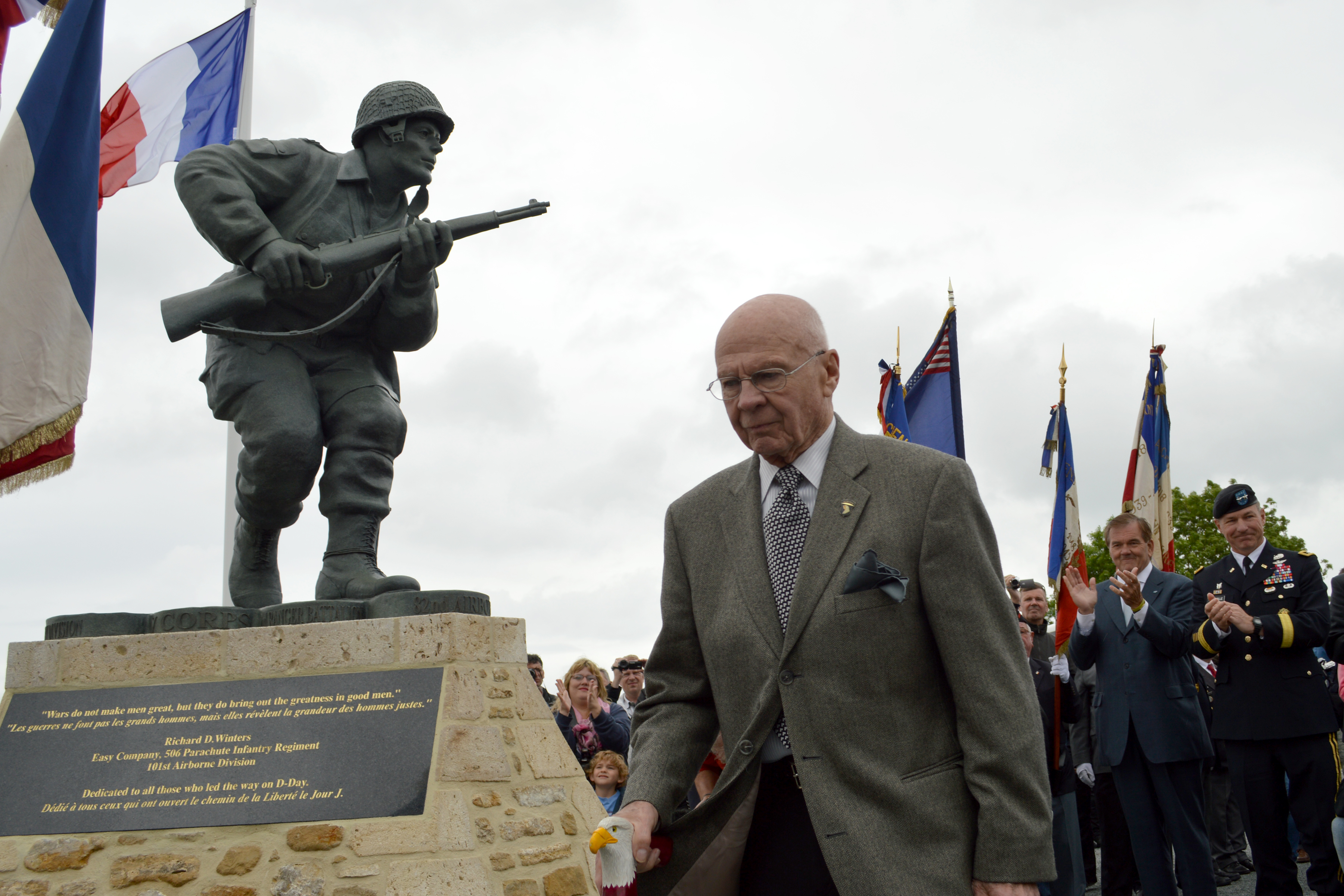
Richard D. Winters Monument

The caption says, “Wars do not make men great, but they do bring out the greatness in good men.” Now let’s see what Dick Winters did during World War II.

MIssion: locate and destroy artillery
Mission: locate and destroy enemy artillery

Brecourt Manor

I want to link to this article from Investors Business Daily about Lt. Winters action at Brecourt Manor.

Here’s the summary of what Dick Winters did on the morning of June 6th, 1944:

First Lt. Dick Winters leapt into leadership on D-Day, June 6, 1944. His commander’s aircraft was shot down as the men parachuted at 600 feet. When Winters headed to earth, he was in charge of a small platoon.

When he landed, he had to command Company E with 148 men, because his commander had been lost along with the plane.

Yet in the chaos, Winters could locate only a dozen other soldiers for their first task: take out a 50-man German artillery battery.

“Winters ordered his assault force to strip down to only essential weapons — guns and grenades — to use against the well-prepared defenses, then deployed his machine guns to cover his advances,” Keith Huxen, senior director of research at the National WWII Museum in New Orleans, told IBD. “Waiting for the proper moment, he led a charge across an open field, gaining the first gun placement, and then they moved down the trenches, systematically destroying each gun.

“In the process, Winters discovered a map detailing all German gun positions to kill American soldiers coming up from Utah Beach, which saved many lives.”

Joined by five reinforcements during the fight, Winters lost four dead and six wounded. The Yanks managed to kill 15 Nazis, capture 11 and wound many others.

Winters’ maneuvers are still studied at West Point as a case of successfully attacking a fixed position, despite being outnumbered.

Winters (1918-2011) was born in Ephrata, Pa., and the family moved to Lancaster when he was 8.

He later attributed his character and desire to go to church regularly to his mother.

Winters attended local Franklin & Marshall College and earned an economics degree with top honors in 1941. He enlisted in the Army in August to shorten his service time, rather than wait to be drafted if America was to join the war.

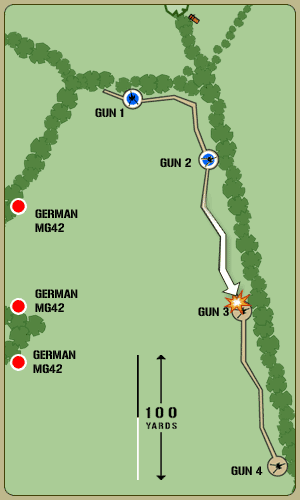
Here’s where everything was, and the Rangers attacked through the trenches containing the four guns, while being raked with fire from multiple MG42 heavy machine guns across the open field.

Assaulting the guns at Brecourt Manor

If this sounds familiar, it’s because he led one of the most famous actions in the Normandy invasion, and you may have seen it portrayed in the Band of Brothers DVD series.  But the article notes that when Dick Winters read the script, “he asked that the profanity be cut from the dialogue of his character, since he never swore”. When the producers told him it was too late to change it, he wrote them a letter of resignation from the production, because “I don’t want these boys and girls thinking it is acceptable using profanity”. In the end, the cleaned up his swearing.

If you are looking for a reason to buck the culture and stop swearing, there’s a good reason for you right there – Dick Winters never used profanity.

You can watch the scene from Band of Brothers in low resolution here:

If you play Combat Mission, like I do, you can watch a 28 minute AAR from the simulation of the battle.

The article talks about a lot of the actions that Winters participated in during World War II.

Operation Market Garden

More from the article, this time Operation Market Garden:

Near Nijmegen on Oct. 5, Winters’ platoon was a position where any movement carried risks. Rather than retreat when fired on by a larger force behind a dike, he led a charge to the top and on the other side discovered a company of 150 Nazi SS troops. Despite having only 40 men, the Americans opened up with everything they had, then shot up a company of enemy reinforcements.

The fray ended with 50 Germans dead, 11 POWs and countless wounded, with few casualties among the Americans.

“This was Easy Company’s crowning achievement of the war and my apogee as a company commander,” Winters told Kingseed. “This demonstrated its overall superiority, of every soldier, of every phase of infantry tactics: patrol, defense, attack using a base of fire, withdrawal and, above all, superior marksmanship with rifles, machine guns and mortar fire.”

Dick Winters is a brave man, someone I admire him very much. And I am grateful for men like him.

I blogged about another hero of the 101st Airborne Division, Ronald Speirs, in a previous post.